

Most SEO audits follow a familiar pattern. A crawler runs through your site, surfaces technical issues, an analyst reviews the output, and you get a report with a list of fixes: broken links, slow page speeds, missing meta descriptions, duplicate content flags, and a handful of keyword gap recommendations. It’s useful. It’s also incomplete in ways that have become increasingly consequential.
A quantum SEO audit goes significantly further. It doesn’t just surface technical issues and content gaps — it maps the entire semantic and entity architecture of your site, models how search engines perceive your topical authority, identifies probability-weighted opportunity clusters, and produces a strategic picture of your site’s search positioning that traditional audits simply can’t generate.
What it reveals is often surprising — and almost always more actionable than a standard technical crawl report.
What a Traditional SEO Audit Misses
To appreciate what a quantum audit adds, it helps to be specific about what traditional audits typically don’t cover.
Semantic coverage gaps — Traditional audits identify which keywords you’re ranking for and which keywords your competitors rank for that you don’t. They don’t model the full semantic territory of your domain — the complete probability distribution of relevant search intent — and identify where in that territory your coverage is absent, thin, or misaligned.
Entity authority analysis — Standard audits don’t assess how clearly search engines associate your site with specific real-world entities — the topics, organizations, people, products, and concepts that define your domain. Entity authority is increasingly central to how Google evaluates topical relevance, but it’s invisible to standard crawl-based audits.
Internal link graph topology — Traditional audits flag pages with no internal links and sometimes assess anchor text patterns. They don’t model the graph topology of your internal link structure — the centrality distribution, cluster density, bridge page positioning, and authority flow patterns that determine how effectively your site accumulates and distributes topical authority.
Semantic intent alignment — Traditional content analysis assesses whether pages are optimized for their target keywords. It doesn’t assess whether the content’s semantic vector aligns with the full intent distribution behind the queries it’s targeting — the deeper alignment signal that AI-powered ranking systems actually evaluate.
Probability-weighted opportunity prioritization — Traditional keyword gap analysis identifies missing keywords ranked by search volume. Quantum analysis ranks opportunities by expected value — considering search volume, competitive difficulty, your site’s existing authority in the semantic neighborhood, and the compounding potential of the opportunity within your strategic content architecture.
The Components of a Quantum SEO Audit
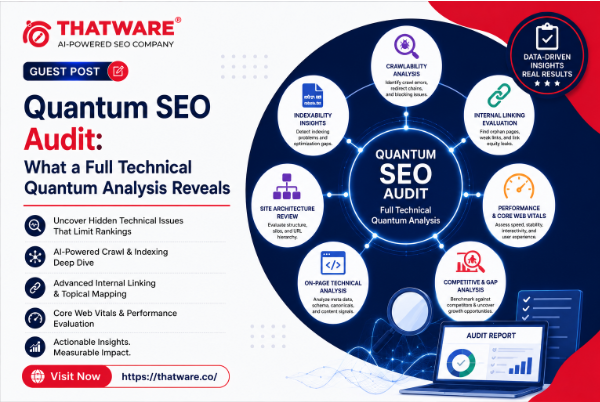
Quantum SEO audit services cover several distinct analytical components that together provide a comprehensive picture of your site’s search positioning.
Technical Foundation Analysis
The quantum audit doesn’t skip the technical basics — it treats them as table stakes that need to be confirmed before the deeper analysis is meaningful.
Crawl architecture assessment — Not just “what’s broken” but “how is Googlebot experiencing your site?” Server log analysis overlaid with site architecture mapping to understand which pages are crawled, at what frequency, and how efficiently Googlebot navigates between content areas.
Indexation health — What percentage of your page inventory is indexed? What’s in Google’s index that shouldn’t be (thin, duplicate, or low-value content), and what’s missing that should be there?
Core Web Vitals and page experience signals — Technical performance assessment for the pages that matter most, not just the site average.
Structured data audit — What schema markup is implemented, where is it missing, and where is it implemented incorrectly? This is more significant in a quantum audit because entity annotation through structured data is a primary tool for building entity authority.
Semantic Architecture Analysis
This is where the quantum audit diverges meaningfully from traditional audits.
Topic model analysis — Using NLP processing across your entire content inventory to identify the topics your site actually covers and how comprehensively it covers them, regardless of how the content is formally organized or tagged.
Semantic territory mapping — Modeling the full semantic field of your domain — the probability distribution of relevant search intent — and mapping your content coverage against it. This identifies not just “missing keywords” but “missing semantic territory” — areas of intent space where your coverage is absent or insufficient.
Intent alignment scoring — Assessing how closely each piece of ranking content’s semantic vector aligns with the intent distribution of the queries it appears for. Low alignment scores indicate content that’s ranking below its potential because it’s not fully satisfying the range of intents behind the query.
Entity coverage audit — Mapping which entities in your domain’s knowledge space are clearly addressed in your content, which are tangentially covered, and which are absent. Comparing your entity coverage to competitor entity coverage to identify entity authority gaps.
Authority Architecture Analysis
Internal link graph topology modeling — Using graph analysis to map the centrality distribution, cluster density, and authority flow patterns of your internal link structure. This identifies pages that are semantically important but link-starved, and pages that are receiving disproportionate link equity relative to their semantic priority.
Anchor text semantic coherence — Analyzing whether your internal link anchor text consistently reinforces the semantic associations you want your highest-priority pages to own, or whether anchor text entropy is weakening these signals.
External authority profile analysis — Beyond standard backlink metrics, analyzing the semantic coherence of your external link profile. Are you receiving links from semantically related sources? Is your external authority profile reinforcing or diluting your topical authority signals?
What the Audit Output Looks Like
A quantum SEO audit produces several distinct output documents:
Semantic territory map — A visual representation of your domain’s semantic space, showing where your content has strong coverage, where it has thin coverage, and where it has none.
Entity authority gap report — A structured analysis of which entities in your domain your site is not clearly associated with, with recommended interventions for each gap.
Internal link architecture redesign brief — A specific redesign plan for your internal link structure, based on the graph topology analysis, with prioritized implementation steps.
Opportunity priority matrix — A ranked list of content and optimization opportunities, each with probability-weighted expected value estimates, that drives the strategic content roadmap.
Technical remediation checklist — The familiar list of technical fixes, but prioritized by semantic impact rather than just severity.
What Organizations Discover
Quantum SEO pricing / packages for a comprehensive audit engagement typically reveals findings that surprise even sophisticated SEO teams:
Semantic territory blindspots — Most organizations find that their content covers a smaller fraction of their domain’s full semantic territory than they assumed. Areas they thought were well-covered turn out to have significant intent distribution gaps.
Entity authority misalignments — Sites often discover they have strong entity associations in some areas and near-zero entity authority in adjacent areas that are equally important to their business.
Internal link equity pooling — Almost universally, the internal link graph analysis reveals that link equity is pooled in a handful of high-linked pages while large clusters of semantically valuable content are functionally isolated from authority flows.
Intent-ranking misalignment — Pages that “should” be ranking better often have specific intent alignment gaps — they’re covering the topic but not serving the full distribution of intent behind the queries they’re targeting.
These discoveries are the value of the quantum audit. Not a list of broken links, but a genuine strategic picture of why your site is performing the way it is and precisely what would need to change to perform differently. That’s the difference between an audit that produces a to-do list and one that produces a strategy.